

Our Finding Process
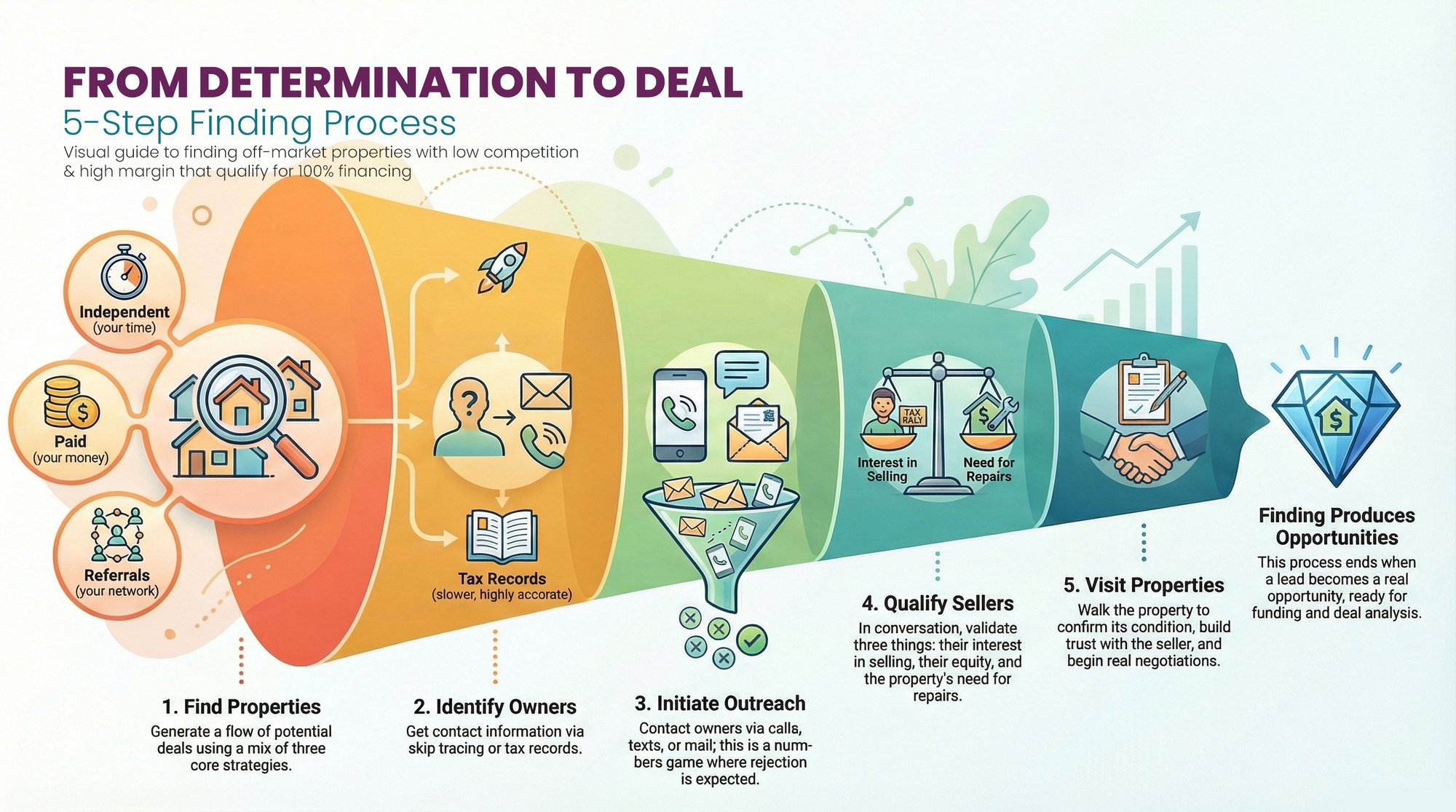
5-Step Process
A clear, step-by-step guide from lead generation to real opportunity This page walks you through the complete finding process so you understand how deals are sourced, filtered, and converted into real opportunities. Finding is a funnel — most properties and conversations do not become deals, and that is expected. The goal is consistency, not perfection. Finding ends when a property has been physically visited and confirmed as a real opportunity. Funding begins immediately after.
Generating a steady flow of potential motivated sellers using multiple lead strategies.
Obtaining reliable contact information for property owners.
Starting contact with property owners to surface interest.
Determining whether a conversation represents a real potential deal.
Confirming that a lead is a real opportunity.
The Details
Step 1: Find Properties
What happens: You source properties using independent, paid, and referral-based finding strategies.
The Details: There are three primary categories of finding strategies:
1. Independent Finding Strategies - These rely primarily on your time and effort. You may use data to improve efficiency, but you are not paying for leads. Like driving for dollars, vacant properties, and estate sales. These strategies trade time for opportunity.
2. Paid Lead Strategies
These involve paying for exposure, impressions, or leads to accelerate responses. Things like post-cards, bandit signs, and google ads. Paid strategies trade money for speed and volume, while still relying on good targeting to control costs.
3. Referral Lead Strategies
These leverage other people’s time, relationships, and networks. Things like probate and estate attorneys, funeral insurance agents, or moving companies These strategies require relationship-building and often include referral fees or commissions.Step 2: Identify Owners
What happens: You gather phone numbers, emails, and mailing addresses using multiple methods.
The Details: There are several ways to identify and contact owners, each with different trade-offs.
1. Skip Tracing - Skip tracing typically returns phone numbers, emails, and names with about a 70–80% hit rate. Often, multiple phone numbers and emails are returned per property. The advantage is volume and speed. The downside is accuracy — some data will be outdated or incorrect. This is normal and expected.
2. Tax Record Mailing Addresses - Tax records provide a highly reliable and comprehensive owner mailing address because tax bills must be sent somewhere. Through Investor’s Edge software, you can access this data for virtually every property. This method is slower for direct contact but extremely accurate.
3. Door Knocking & Neighbor Outreach - In some cases, owners can be contacted directly by knocking on the property itself or speaking with neighbors to obtain owner contact information. This approach is time-intensive but can be effective in targeted areas.Step 3: Initiate Outreach
What happens: You reach out through calls, texts, emails, postcards, and in-person outreach.
The Details: This step is a numbers game. You will contact:
- People with incorrect contact information
- People who are upset or confused by your outreach
- People who are polite but not interested
- People who are interested but unrealistic
You do not know which category someone falls into until you reach out. This is normal. Rejection, wrong numbers, and frustration are part of the process — not signs of failure. Outreach messages are simple and respectful, often including an informal offer range or a question about interest in selling. The goal is to invite a response, not to negotiate or convince. Consistency matters more than perfection.
Step 4: Qualify Sellers
What happens: You speak directly with property owners to validate key criteria.
The Details: Once you reach an owner, your goal is not to close a deal — it is to qualify whether the opportunity is worth further time. You are validating three primary things:
- Interest – Are they open to selling at all?
- Equity – Is there enough equity to support a discounted purchase?
- Repairs – Does the property need work? If not, it likely cannot be purchased low enough to add value or obtain 100% financing.
If any of these are missing, the deal typically stops here. This step protects your time and energy.
Step 5: Visit Properties
What happens: You meet the seller at the property to walk it, assess condition, and begin negotiations.
The Details: This is where finding transitions into opportunity.
During the visit, you:- Walk the property and validate the true condition
- Identify visible repair needs and take photos
- Build trust and rapport with the seller
- Begin real negotiation based on facts, not assumptions
You may bring a contract with you and, in some cases, involve a contractor to help assess scope. This visit provides the real-world information needed to accurately estimate rehab costs using tools like the Bluehammer Rehab Estimator.
FREQUENTLY ASKED QUESTIONS
The Finding Process is often where people feel the most uncertainty — where to look, who to talk to, and how to know if a deal is real. These questions come up for almost everyone, whether you’re brand new or experienced. This FAQ is designed to clarify how the process works, set realistic expectations, and show how our system helps you avoid common mistakes while turning motivated sellers into real opportunities.
The Finding Process is everything that happens before funding.
Its purpose is simple: turn motivated sellers into real opportunities.
It ends when you’ve:
-
Talked to the seller
-
Visited the property
-
Confirmed condition and motivation
Once that happens, the deal moves into the Funding Process for analysis and financing.
No.
There are three categories of finding strategies, and you can use one or combine them:
-
Independent leads (your time): driving for dollars, calling, door knocking
-
Paid leads (your money): postcards, bandit signs, online ads
-
Referral leads (your network): agents, wholesalers, attorneys, professionals
Our system is designed to support any mix, based on your budget, schedule, and skill level.
Yes—and that’s intentional.
Most people don’t fail because they can’t find properties.
They fail because they don’t know what to say or waste time on the wrong people.
We provide:
-
Conversation scripts
-
Qualification worksheets
-
Training videos
-
Clear criteria for when to move forward or walk away
You’re never guessing what to say or what matters.
Two things:
-
Targeting everything instead of the right properties
-
Spending time on sellers who aren’t motivated
Our software filters for probable equity and probable motivation so you’re not wasting time or money on dead ends.
We use multiple data sources and signals, including:
-
Public mortgage and tax data to estimate equity
-
USPS records to identify vacancy
-
Court records (divorce, probate, bankruptcy)
-
MLS data for long-listed or underpriced properties
-
AI photo analysis to identify distressed properties
You’re not guessing—you’re filtering noise.
You have multiple options built into the system:
-
Skip tracing (phone numbers & emails; fast, but imperfect)
-
Tax record mailing addresses (slow, but highly accurate)
-
Door knocking (direct, personal, and effective)
You can choose speed, accuracy, or a combination.
That’s normal—and expected.
This is a numbers game, especially early on.
You will:
-
Reach wrong numbers
-
Talk to people who aren’t interested
-
Get rejected
The system is designed to minimize wasted effort and help you quickly move on to qualified conversations.
Before visiting, you’re qualifying three things only:
-
Interest in selling
-
Enough equity
-
Clear need for repairs
If those three aren’t present, you don’t go further.
This keeps your time focused on real opportunities.
Not usually.
Most first visits are about validation, not final pricing. You’ll use this information later with our rehab tools and contractor qualification process.
This is common.
We give you:
-
Tools to explain why FHA or retail buyers won’t work
-
Repair and cost calculators to show reality
-
Training on how to frame investor value honestly
You’re not pressuring sellers—you’re educating them.
Yes.
Real deals aren’t linear.
Our system lets you move forward or backward as needed—without losing data or momentum.
It depends on:
-
Your activity level
-
Your market
-
The strategies you use
Some members find opportunities in weeks, others in months.
The key is consistent action with the right targeting.
Not just finding properties.
The real goal is to protect your time, reduce mistakes, and only move deals forward that can actually get funded and make money.