


The real estate investment arena hasn’t exactly been rolling out the red carpet for new investors, but things are about to change. According to industry insiders, we’re stepping into a Goldilocks zone over the next six to 12 months. For the last few years, you couldn't breathe on a property without ten cash offers beating you. That frenzy has finally cooled (at least for the moment).
Interest rates have settled in the mid-6% range and are projected to dip slightly into 2026. This will push sellers who were holding onto their 3% rates to realize that life goes on, and they have to sell. As a result, more distressed inventory is about to hit the market.
But to turn a profit, you need to buy deep (at a discount) and move fast. Speed is the currency of this market, which is why finding proper financing for first-time fix-and-flip is of utmost importance, The Investor’s Edge reports.
Why a Hard Money Loan?
Conventional mortgages typically require a property to be habitable, meaning it must have a functioning HVAC system, a roof, and a kitchen.
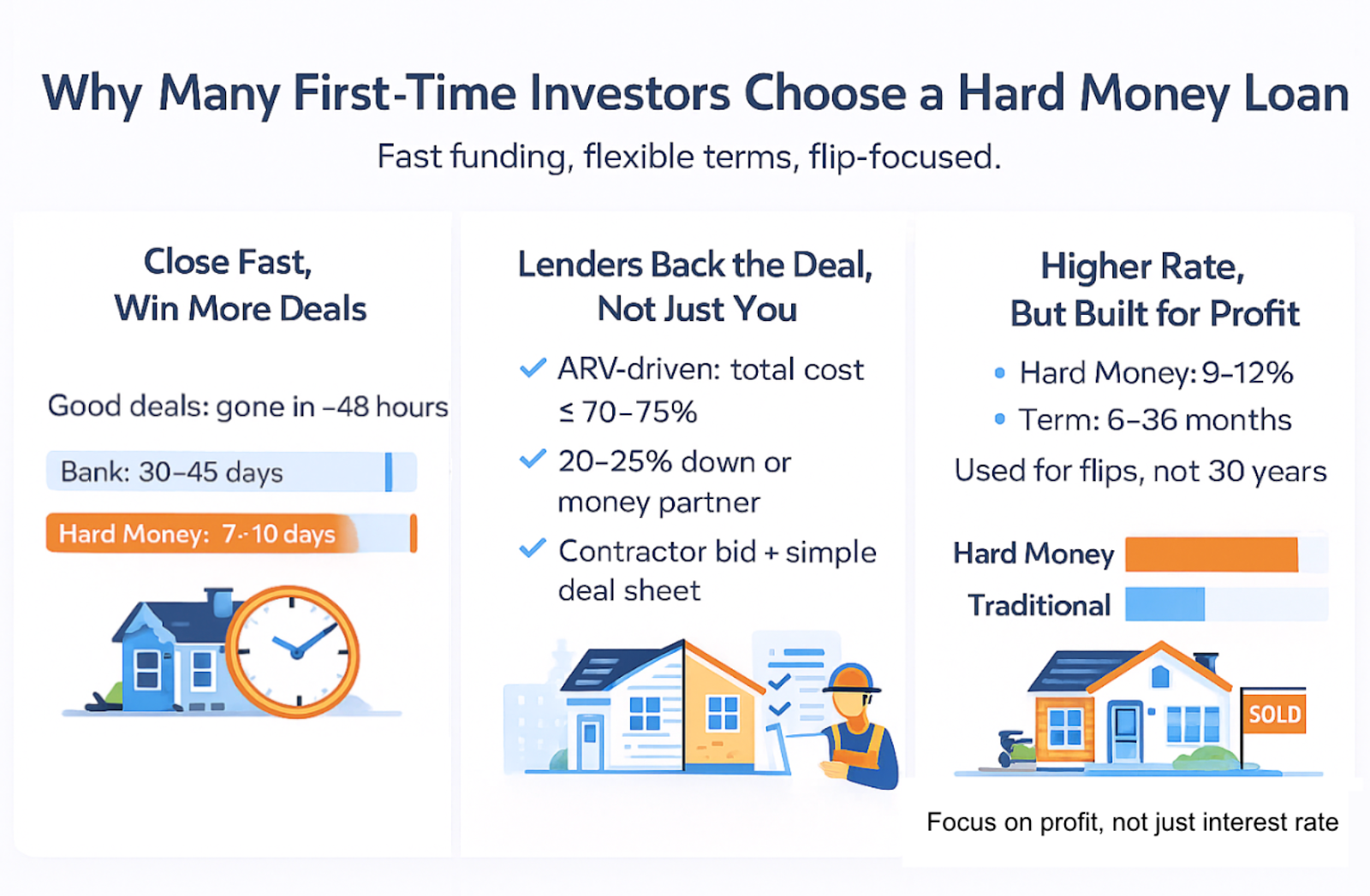
Not to mention that a bank loan takes 30 to 45 days to close … few investors have that much time to throw around. In this market, good deals last about 48 hours, and then they’re gone. You’re either ready to act or not.
This is why the best fix-and-flip loans for first-time investors need to be speedy, without worrying too much about the property's current condition. A hard money lender doesn't care if there's a hole in the roof; they care about the house's future value. Plus, a hard money loan can close in seven to 10 days, making it much easier to negotiate against cash offers.
Financing for First-Time Fix-And-Flip
Hard money lenders want to lend, so they won’t look for reasons to say "no" like a bank would. However, this doesn’t mean it’s something anyone can get.
When you’re looking for money for your first fix-and-flip, you’ll notice lenders want to know three things:
Can you pay me back if you fail?
This is the biggest hurdle. You need skin in the game (so to speak). For a first-timer, expect to bring 20% to 25% of the purchase price plus closing costs.
If you don't have that cash, bring a money partner who provides the capital in exchange for a share of the profits. The lender doesn't care whose money it is, as long as it's there.
Do you know what you are buying?
Don't just say "I think it's a good deal." Show them. Submit a clear one-page spreadsheet showing the Purchase Price, Renovation Costs, and the ARV (After Repair Value). Ensure your total cost (purchase + rehab) is 70-75% of the ARV.
Can you actually fix it?
Since you have no track record, you must borrow someone else's credibility. If you want the loan, avoid saying you’ll do the work (or part of it) unless you’re a licensed General Contractor with a professional team at your disposal.
If you’re not, submit a detailed bid from a licensed General Contractor with your application. This makes approval significantly easier.
Extra tip: As a beginner, you have a lot to learn, which is why it’s best to have some sort of expert guidance on your side.
It’s also important to make sure that you have enough time to make the repairs needed to the home you plan to flip. Even if you aren’t doing a majority of the repairs on your own, you’ll still need to hire contractors, handle permitting, and ensure the work meets your standards. Not considering the time commitment needed to fix and flip a home is one of the biggest mistakes new investors make.
Hard Money Loan vs. Traditional Loan
We’re just going to come out and say it: Hard money is more expensive than a classic mortgage. But you’re not buying a home to live in; you are buying a business inventory. You don’t need the money to settle down, but to take advantage of an opportunity.
While there are other options you can explore, hard money financing is the most reliable for a pure investment flip. That, of course, is if you don’t already have the money or if someone close to you is willing to make the investment and split the profits.
If you’re still undecided, here’s why seasoned pros can help steer first-time real estate investors toward hard money loans instead of traditional financing.
Collateral focus
Hard money lenders focus on the house's ARV (After Repair Value). They look at what might be a decrepit old property and see its value once it's fixed. If the deal has a wide profit margin and you can prove your reliability, they’ll have no problem lending you the funds.
A conventional bank focuses on your debt-to-income ratio (DTI) and credit score. They also want the house to be in good enough condition so you can live in it for a few years (at least). If the kitchen is gutted or the roof is leaking, no traditional bank will award you a mortgage.
Loan term and purpose
Hard money loans are a short-term solution with repayment terms of six to 36 months. They are strictly designed to bridge the gap between buying the wreck and selling the gem. You are not meant to keep this loan long-term.
In contrast, a mortgage is a 15 or 30-year commitment. They are designed for stability and slow equity build-up, not for a quick exit.
Flexibility and documentation
A hard money lender doesn't need to see two years of W-2s or grill you on why you changed jobs three months ago. They want to see the Scope of Work and a clear Exit Strategy.
There’s no drowning in paperwork, as it happens with a traditional house loan, and no need for explanation letters for every large deposit in your bank account. The lending process is flexible
and quick.
Interest rate and fees
Speed and flexibility come at a price, so expect rates between 9% and 12% (sometimes higher for first-timers) plus two to three points (origination fees) upfront. This is a bit steep compared with the 6-7% rates (currently) for a traditional loan.
So, yes, hard money is more expensive. But don't look at the interest rate; look at the cost of capital. Paying 10% interest for six months on a deal that makes you $40,000 profit is just a business expense.
The starting line
A hard money loan is the fastest, most predictable way for a beginner to buy properties that hold great potential. If you love the fix-and-flip business and want to get things moving, this type of loan is your starting line.
Just make sure to get some solid backing for your first deal. Work with experts and always ask for advice from those who know better. Also, never let a hard money loan mature past its term, or you’ll lose your shirt. Now, go find a great deal!